I’ve spent my career building software and nearly a decade sitting on municipal boards. That dual perspective has made me deeply allergic to a specific kind of vendor pitch: the one telling towns they need to "adopt AI," as if it’s a single ideology you either blindly embrace or stubbornly resist.
That framing is useless. AI is a specific tool in the software toolbox. It is an incredibly powerful tool with amazing potential, but it is still only one tool. You have probably heard the trap of Abraham Maslow’s famous axiom: "If the only tool you have is a hammer, you tend to treat everything as if it were a nail." If take an "we must adopt AI" mentality you will be trying to apply it to every problem even when it is totally counterproductive to do so. The real task is determining which municipal problems AI should actually touch, and which it should be kept well away from.
What follows is a "traffic light" guide to where AI should be encouraged based on its potential benefits versus places where AI will only frustrate and cause distrust with residents.
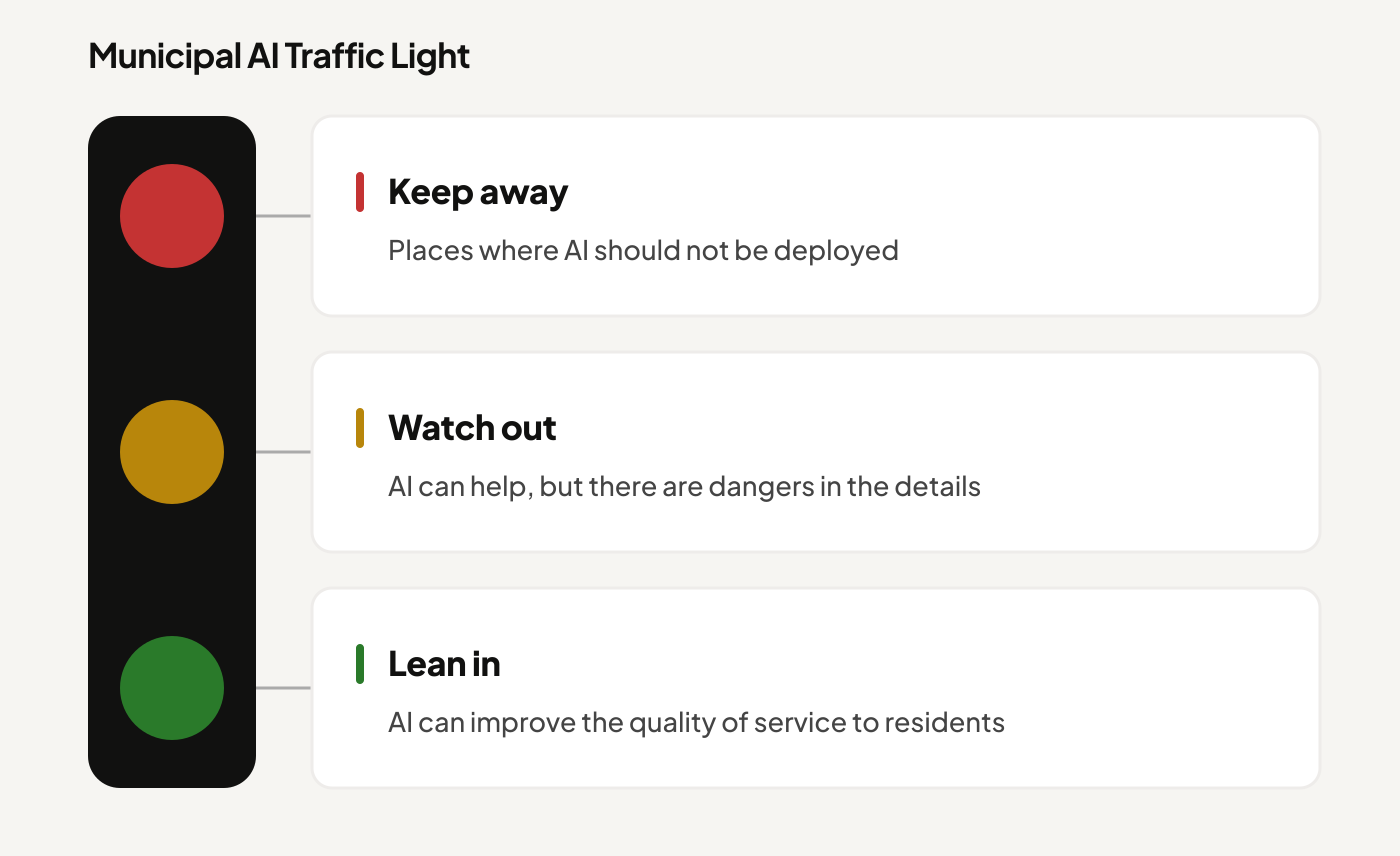
🟢 Green Light: Lean in here
-
Repetitive back-office work. Reconciling routine data, flagging anomalies for a person to inspect, searching, sorting and routing incoming requests, drafting boilerplate. Unglamorous, which is the point. This is the load that keeps skilled staff from doing the work that actually needs their judgment.
-
Searching document records. If you have digitized records, you probably have a record-keeping system that has a search function. Traditionally the search function appears as a large page of input fields, each with their own rules. Searching the database most often results in a "No Results" message, requiring a "trial-and-error" approach until the right record is found. An AI system is perfect here, allowing you to make common-language searches and get meaningful results.
-
Turning recordings into first drafts of minutes. This is the highest-value, lowest-risk application I know of in municipal work. Someone has to turn meetings into minutes: hours of transcription and formatting, recurring forever. Municipal meetings are sort of like soccer games—a lot of time spent running and walking in circles (the discussion) surrounding a few moments of really intense activity (the motions). Minutes are supposed to be a highlight reel. To make them, someone has to listen through the entire meeting to capture every motion and vote, and then make editorial judgments on the discussion. A three-hour meeting is more than three hours of work. This is a task begging for intelligent software.
-
Tasks that currently sit at zero. Ask yourself: "Is anyone actually doing this right now?" In many town halls, the answer for certain valuable tasks—like indexing decades of historical zoning decisions, proactively searching for grants, or cross-referencing old bylaws—is simply "no." No one has the time. Here, the benchmark for software changes entirely. AI doesn't need to perfectly replace a full-time expert; it just needs to be better than a blank page. An imperfect first draft that a human reviews is infinitely better than a task that never happens at all.
🟡 Yellow Light: Watch out here
-
Answering routine, high-volume resident questions. Cities have had some success putting AI on 311-style services and permit-status questions (e.g., What are the trash pickup days? Where is my application?). Be warned, though: generic AI deployments are prone to making up, or "hallucinating," information if the requested data isn't perfectly clear. The techniques used to counteract that effect often result in a system so restricted that it can't actually answer user questions. This is a dangerous area where a slick product demo rarely translates to a real-world deployment. Getting enough structured data into the AI so that it can accurately answer questions is a massive undertaking.
-
Generic AI Solutions. The problem with "one-size-fits-all" AI is that it isn't actually particularly good at anything. For example, a generic AI can generate a summary of a meeting, but a summary is not the same thing as actual, formal minutes. Deploying a generic AI for a highly specific municipal task will likely result in more work, as staff must spend their time identifying and fixing the model's shortcomings to force it into the right shape.
-
Blind AI Solutions. AI is software. Any software that doesn't put user control and human verification front and center is a problem. Watch out for AI vendors that promise their solution will "take care of everything" behind the scenes. If the system operates as a black box and doesn't allow a human to easily review its work, it is a liability, not a tool.
🔴 Red Light: Keep it away from here
-
Anything presented as authoritative that no one verifies. In 2025, Deloitte Australia had to partially refund the Australian federal government on a report worth about A$440,000 after the deliverable was found to contain AI-generated errors, including references that didn't exist. A global firm, a six-figure engagement, and the model still invented sources with total confidence. If a document goes out under the town's name as fact, a human who knows the material has to verify every load-bearing claim. "The AI wrote it" is not a sentence anyone wants to say at a public meeting.
-
Discretionary decisions about individual residents. Whether to grant a variance. How to weigh public testimony. Who qualifies for a hardship exemption. These are judgment calls the public entrusted to accountable human officials. AI can organize the information in front of the decision-maker, but it must not become the decision-maker. Even if these tools aren't making the final justdment there is worrying potential to prejudice a human user towards a certain decisions. Stay away.
-
Sensitive data in tools the town doesn't control. This is the quiet crisis in government AI right now. Surveys show around two-thirds of employees already use free personal AI accounts for work, often pasting sensitive information into them. Many free AI tools save user inputs to train their models, and that sensitive data "leaks" out later. Banning AI isn't the answer—giving staff a sanctioned tool for the specific job is.
-
Nothing where math is involved. AI is incredible, truly, but not at spreadsheets and math. You can use an AI to help write Excel formulas, but always use Excel (or a calculator) to calculate numbers. Skip the AI for the actual math.
-
Building barriers between residents and town staff. Using AI to help residents get answers faster is something I mentioned before that has great potential. Forcing residents to go through an AI chat before they reach human assistance, hard pass. Use AI to open the door for those who are looking to engage, not as a wall to keep questions out.
Knowing which list a task is on is half the work. The other half is implementing it in a way that protects the town.
Better use of AI in municipalities...so moved...